.svg)
Go-to-Market Strategy: How to successfully launch and scale your product
A strong Go-to-Market strategy defines your audience, positioning, pricing, and channels—helping you launch faster, reduce risk, and scale sustainably.



How to successfully launch and scale your product?
A great product alone isn’t enough. Without a solid Go-to-Market (GTM) strategy, even the best solutions struggle to find traction. Are you launching a startup, expanding into a new market, or introducing a new product? Having a structured GTM plan is the difference between rapid growth and wasted potential.
What is a Go-to-Market strategy?
A Go-to-Market strategy is a step-by-step guide that defines how a business will launch, position, and sell a product or service to its target audience. It ensures that you reach the right customers, differentiate from competitors, and achieve sustainable growth.
A well-executed GTM strategy helps businesses:
- Reduce time to market
- Increase product adoption and customer retention
- Maximize return on investment (ROI)
- Align sales, marketing, and product teams
Key components of a go-to-market strategy
1. Target market & ideal customer profile (ICP)
Before launching, define who your ideal customers are and where they exist. Consider:
- Demographics: Age, gender, location, income level
- Firmographics (for B2B): Company size, industry, revenue, decision-makers
- Psychographics: Pain points, needs, behaviors, interests
- Buying Behavior: Where do they search for solutions? What influences their decisions?
2. Unique Value Proposition (UVP)
Your UVP is what sets your product apart. It should clearly answer:
- What problem does your product solve?
- Why should customers choose you over competitors?
- How does your solution deliver better results?
3. Product positioning & messaging
Positioning defines how your product is perceived in the market. It should be clear, compelling, and instantly convey value.
Example Positioning Statement:
“[Product Name] helps [Target Audience] solve [Problem] by [Key Benefit], unlike [Competitor].”
Messaging should be consistent across all channels and include:
- Tagline: A concise, memorable statement
- Elevator Pitch: A 30-second summary of your product’s value
- Key Benefits: Clear, results-driven advantages for users
4. Pricing strategy
Pricing impacts adoption, revenue, and positioning. Common pricing models include:
- Freemium: Free basic version with paid upgrades (Dropbox, Slack)
- Subscription-Based: Monthly/yearly payments (Netflix, HubSpot)
- Usage-Based: Customers pay based on usage (AWS, Twilio)
- One-Time Purchase: Traditional sales model (software licenses, Books).
5. Sales & distribution strategy
How you sell and distribute your product defines how efficiently you reach customers. Common GTM sales strategies include:
- Inbound Sales: Customers find your product through SEO, content marketing, and organic channels
- Outbound Sales: Cold emails, LinkedIn outreach, and direct sales teams
- Product-Led Growth (PLG): Users experience the product before purchasing (free trials, demos, self-service onboarding)
- Channel Partnerships: Resellers, affiliates, or distributors selling your product
6. Demand generation & marketing strategy
Key tactics include:
- SEO & content Marketing: blog posts, landing pages, keyword optimization
- Social Media & community engagement: LinkedIn, Twitter, and industry forums
- Paid ads & performance marketing: Google Ads, Facebook Ads, LinkedIn Ads
- Email marketing & nurturing campaigns: automated sequences to convert leads
- Webinars & leadership: educating potential customers about your product
7. Customer onboarding & retention
Acquiring customers is only the first step. Retention drives long-term success. Strong onboarding and support strategies include:
- Seamless onboarding: tutorials, welcome emails, knowledge bases
- Customer support: live chat, help centers, FAQs
- Retention strategies: personalized follow-ups, loyalty programs, engagement emails
Go-to-market frameworks & models
- The AARRR Framework (Pirate Metrics)
- Acquisition: How do you attract customers?
- Activation: How do you ensure users experience your product’s value quickly?
- Retention: How do you keep users engaged?
- Revenue: How do you monetize customers effectively?
- Referral: How do you encourage customers to bring in others?
- The Bowling Alley Framework
This model suggests starting with a niche market, then expanding into adjacent markets gradually. It’s ideal for B2B SaaS and tech startups looking to scale systematically.
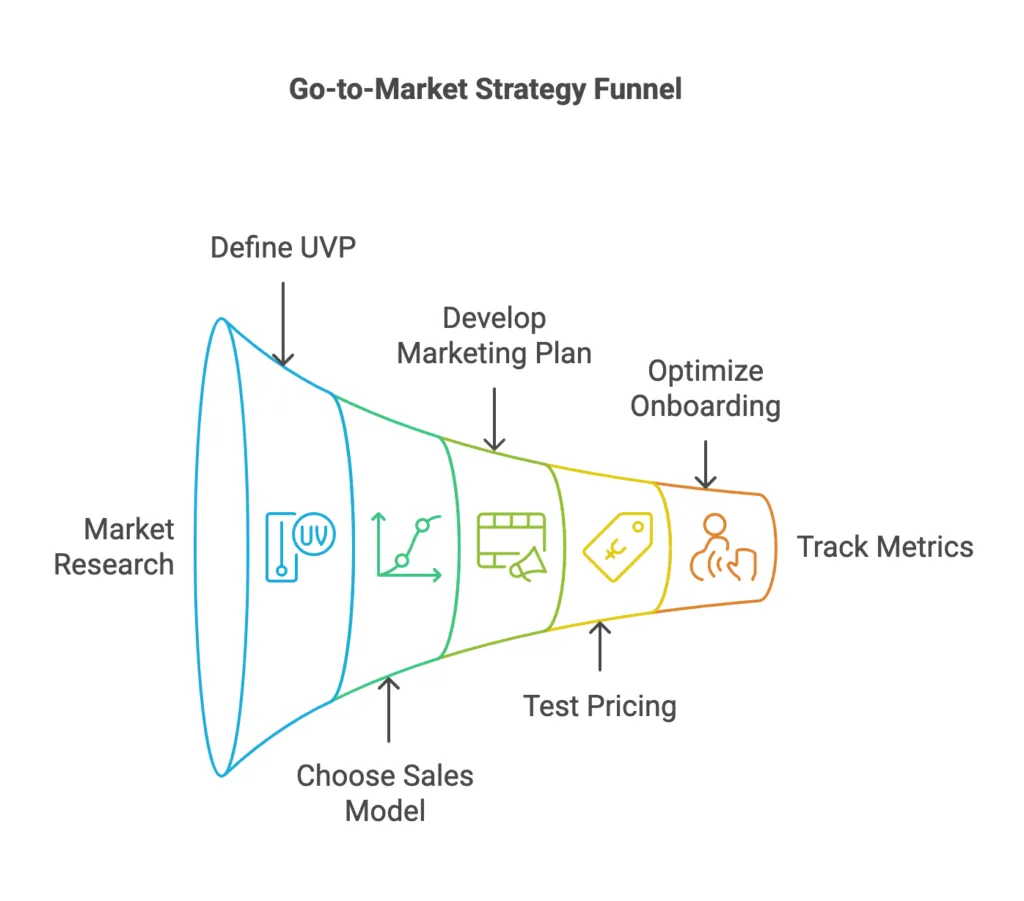
How to create a go-to-market strategy?
- Conduct Market Research – Identify your ideal customer and competitors.
- Define Your UVP – What makes your product different?
- Choose the Right Sales & Distribution Model – Direct sales, PLG, partnerships?
- Develop a Marketing Plan – SEO, paid ads, email campaigns?
- Test Pricing & Monetization – Subscription, freemium, one-time fee?
- Optimize Customer Onboarding & Retention – Keep users engaged.
- Track Key Metrics & Iterate – CAC, LTV, conversion rates.
Conclusion: Why is a GTM strategy a basic point for your startup success?
A Go-to-Market strategy is not just about launching—it’s about scaling sustainably. By defining your target audience, pricing strategy, marketing approach, and sales channels, you create a roadmap to long-term success.
- A GTM strategy ensures product-market fit and minimizes risk.
- A clear sales, marketing, and retention plan drives sustainable growth.
- Data-driven decisions increase efficiency and revenue.
- Continuous optimization ensures long-term market success.
Building a go-to-market strategy that works is not about guesswork—it’s about strategy, execution, and iteration.
What’s your biggest challenge in launching a new product? Let’s talk!
Facing a unique growth challenge? We’ll build the right solution together.